The Baghdad Battery.
Ancient Device that Produces a 2 Volt Electrical Current!
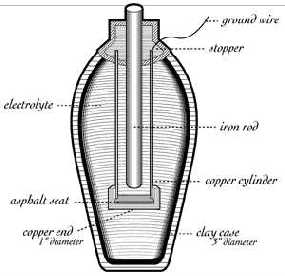 When
the German archaeologist William Koenig became director of the Museum in Baghdad in 1937,
he noticed that one of the objects could have been used as a battery. The yellow clay pot
was dated from around 200 BC, the Parthian era. However the Parthians weren't known for
any cultural or scientific achievements as they were mainly warriors. Others have noted
that the pot is Sassanian and that there may have been some misidentification of the age
or the place it was originally found. It was a 6 inch high clay pot, which had a cylinder
of sheet copper measuring 5 inches by 1.5 inches on the inside. This was welded by a 60-40
lead-tin alloy to the bitumen (or asphalt) top. The bottom of this cylinder was capped
with a crimped in copper disk and was also sealed with bitumen. The rod showed some
evidence of having been eroded with an acidic agent, which gave rise to the idea of it
being a battery. Obviously they had to test the idea. In the 70 they tried to add plain
old pineapple juice (as it would have been the most probable acid people could have used
in ancient times) and found that it yielded about 1.5V. In later experiments with vinegar
and other weak acids up to about 2V were measured. When
the German archaeologist William Koenig became director of the Museum in Baghdad in 1937,
he noticed that one of the objects could have been used as a battery. The yellow clay pot
was dated from around 200 BC, the Parthian era. However the Parthians weren't known for
any cultural or scientific achievements as they were mainly warriors. Others have noted
that the pot is Sassanian and that there may have been some misidentification of the age
or the place it was originally found. It was a 6 inch high clay pot, which had a cylinder
of sheet copper measuring 5 inches by 1.5 inches on the inside. This was welded by a 60-40
lead-tin alloy to the bitumen (or asphalt) top. The bottom of this cylinder was capped
with a crimped in copper disk and was also sealed with bitumen. The rod showed some
evidence of having been eroded with an acidic agent, which gave rise to the idea of it
being a battery. Obviously they had to test the idea. In the 70 they tried to add plain
old pineapple juice (as it would have been the most probable acid people could have used
in ancient times) and found that it yielded about 1.5V. In later experiments with vinegar
and other weak acids up to about 2V were measured. |
 So
what did the ancients do with batteries? Again, after going through history and scraping
together what little knowledge we have from those peoples lives, It was most likely used
for gilding. Yes, putting sheet gold onto cheap silver statuettes or vases. Other ideas
were the use of low voltage for health purposes (i.e. in connection with acupuncture).
However as no other vessels like the Baghdad battery have been found, some archaeologist
say it was a "one off". Me personally I don't think so. It was obviously build
deliberately and it would be a little coincidence to find "the only one ever
made". The truth is that there were so many that we could easily find one even though
most others are now lost or destroyed. So with more than one you can crank your Voltage up
to really useful levels. Whatever we believe it was used for, we are probably wrong, you
don't invent a functioning pen just to stir your soup with... Nici So
what did the ancients do with batteries? Again, after going through history and scraping
together what little knowledge we have from those peoples lives, It was most likely used
for gilding. Yes, putting sheet gold onto cheap silver statuettes or vases. Other ideas
were the use of low voltage for health purposes (i.e. in connection with acupuncture).
However as no other vessels like the Baghdad battery have been found, some archaeologist
say it was a "one off". Me personally I don't think so. It was obviously build
deliberately and it would be a little coincidence to find "the only one ever
made". The truth is that there were so many that we could easily find one even though
most others are now lost or destroyed. So with more than one you can crank your Voltage up
to really useful levels. Whatever we believe it was used for, we are probably wrong, you
don't invent a functioning pen just to stir your soup with... Nici |

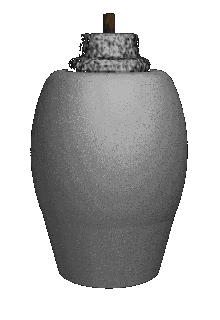 Sitting in the
National Museum of Iraq is a earthenware jar about the size of a man's fist. Its existence
could require history books throughout the world to be rewritten.
Sitting in the
National Museum of Iraq is a earthenware jar about the size of a man's fist. Its existence
could require history books throughout the world to be rewritten.
According to most texts the "voltic
pile," or electric battery, was invented in 1800 by the Count Alassandro Volta.
Volta had observed that when two dissimilar metal probes were placed against frog tissue,
a weak electric current was generated. Volta discovered he could reproduce this current
outside of living tissue by placing the metals in certain chemical solutions. For this,
and his other work with electricity, we commemorate his name in the measurement of
electric potential called the volt.
The little jar in Baghdad suggests that Volta
didn't invent the battery, but reinvented it. The jar was first described by German
archaeologist Wilhelm Konig in 1938. It is unclear if Konig dug the object up
himself or located it within the holdings of the museum, but it is known that it was
found, with several others, at a place called Khujut Rabu, just outside Baghdad.
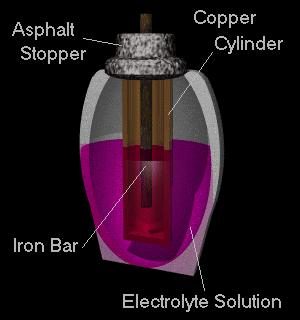
The jars are believed to be about 2,000 years
old and consist of an earthenware shell, with a stopper composed of asphalt. Sticking
through the top of the stopper is an iron rod. Inside the jar the rod is surrounded by a
cylinder of copper. Konig thought these things looked like electric batteries and
published a paper on the subject in 1940.
World War II prevented immediate follow-up on
the jars, but after hostilities ceased, an American, Willard F. M. Gray of the
General Electric High Voltage Laboratory in Pittsfield, Massachusetts, built some
reproductions. When filled with an electrolyte like grape juice, the devices produced
about two volts.
Not all scientists accept the "electric
battery" description for the jars. If they were batteries, though, who made them and
what were they used for?
 Khujut
Rabu was a settlement of a people called the Parthians. While the Parthians were excellent
fighters, they had not been noted for their technological achievements and some reseachers
have suggested they obtained the batteries from someone else. A few people have even
suggested that this someone else was a space
traveler that visited Earth during ancient times.
Khujut
Rabu was a settlement of a people called the Parthians. While the Parthians were excellent
fighters, they had not been noted for their technological achievements and some reseachers
have suggested they obtained the batteries from someone else. A few people have even
suggested that this someone else was a space
traveler that visited Earth during ancient times.
As romantic a notion as this is, there is
nothing about the Baghdad batteries that is high-tech. All the materials used are common
in origin and the manufacture was well within the ability of many of the peoples of that
era. What is surprising about the jars is that somebody figured out how to put the right
materials together in the right way to make a device that has a function which was not
obvious. It is likely that the batteries (if that is what they are) the result of an
isolated and accidental development.
What might they have been used for? German
researcher Dr. Arne Eggebrecht used copies of the batteries to electroplate items.
The electroplating process uses a small electric current to put a thin layer of one metal
(such as gold) on to the surface of another (such as silver). Eggebrecht suggests that
many ancient items in museums that are thought to be gold may actually be gold-plated
silver.
So are these devices batteries? It certainly is
a strong possibility. Even if they are, Count Volta need not be worried. We are unlikely
to change the term used for electrical potential at this late date. His place in history
is assured.