Fishtailing
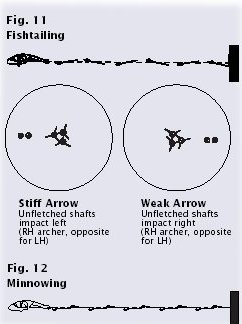
If the arrow leaves the bow with the nock end leaning to one side or the other, fishtailing occurs. The nock end of the arrow will appear to move from side to side as the arrow follows its flight path. See Fig. 11.
Use the Bare Shaft Planing Test to correct fishtailing. Shoot three fletched shafts at a distance of 15 to 20 yards (meters), then shoot two identically-aimed, unfletched shafts. If the unfletched shafts impact left (stiff) of the fletched shafts, as seen in Fig. 11 (for a right-handed archer), either decrease
the spring tension on the cushion plunger, increase bow weight slightly (if your bow weight is adjustable), or increase arrow point weight. If the unfletched shafts impact right (weak) of the identicallyaimed, fletched shafts, as seen in Fig. 11 (for a right-handed archer), increase the spring tension on the cushion plunger, decrease bow weight slightly (if your bow weight is
adjustable), or decrease arrow point weight. Your equipment is basically tuned when the bare shafts and fletched shafts impact at the same or very near the same location. Once you have completed the finer tuning
methods listed for Fine Tuning and Micro Tuning on pages 12-14, do not be surprised if the bare shaft impact changes. It is common on a well-tuned bow to have the bare shaft impact a little low and slightly stiff (to the left of the fletched shafts for a right-handed archer). Occasionally, a good tune may be achieved with the bare shaft impacting slightly weak (to the right of the fletched shafts for right handed archers), but this is less common. When correcting fishtailing using the Bare Shaft Planing Test, you may have a problem adjusting the unfletched shaft's impact to that of the fletched shaft. Your arrows might be too weak (the unfletched shaft impacts to the
right of the fletched shaft for right-handed archers) or too stiff (the unfletched shaft impacts to the left of the fletched shaft for right-handed archers). If, after completing this test, the bare shaft impact is more than
6 inches (15 cm) to the right (weak) or left (stiff) of the fletched shafts at 20
yards (18 m), you will need to change shaft size, or make some modifications to the equipment to achieve a better tune. Follow the suggestions on how to better match the arrow to your bow in the "Adjusting the Bow and Arrow
System" section on page 10.
3. Clearance
Proper clearance is absolutely essential for optimum grouping, consistency and accuracy. This is especially true with ultra-light weight arrows like the UltraLite aluminum, the A/C/E, A/C/C and A/C/C HyperSpeed shafts.
After you have performed the Bare Shaft Planing or Paper Tuning Arrow Test, it is a good idea to check for adequate clearance. To check for clearance, use dry powder foot spray, dry deodorant spray or similar product, applied to
the last quarter of the arrow shaft, fletching, arrow rest assembly and sight window near the arrow rest. Do not disturb the powder sprayed on the arrow and bow while preparing to shoot. The arrow should be shot into a firm
target so that it will not penetrate to the fletching.
Fig. 11 Fishtailing Fig. 12 Minnowing 7
This tear indicates a high nocking point, clearance problem, or a very weak arrow if you are using a release aid. To correct, lower the nocking point 1/16" (1.6 mm) at a time until the high tear is eliminated. If the problem is unchanged after moving the nocking point a few times, the disturbance is most likely caused by a lack of clearance or by an arrow that is too weak (if using a release aid). To identify a clearance problem, check to see if the arrow fletching is hitting the arrow rest. (See "Clearance Problems," page 6.) CR - If no clearance problem exists and you are using a mechanical release, try:
1. A more flexible arrow rest blade if using a launcher
type rest or reduce downward spring tension on adjustable tension launcher rests.
2. Decreasing peak bow weight if there is an indication the arrow spine is too weak.
3. Reducing the amount the shaft overhangs the contact point on the arrow rest.
4. Choosing a stiffer arrow shaft.
This tear indicates a stiff arrow reaction for right-handed archers using finger release
(RF, CF). Left-handed finger release archers will have an opposite pattern. This is an uncommon tear for right-handed compound archers using a mechanical release (CR). However, it can occur and generally indicates that the arrow rest position is too far to the right or that there is possible vane contact on the inside of the launcher rest.
Finger Release (RF, CF)-–To correct:
1. Increase bow weight/peak bow weight.
2. Use a heavier arrow point and/or insert combination.
3. Use a lighter bowstring (less strands or lighter material,
like Fast Flight�).
4. Use a weaker spine arrow.
5. Decrease cushion plunger tension or use a weaker
spring on "shoot around" rests.
6. CF only - Move the arrow rest slightly in toward the
bow.
Mechanical Release Aid (CR)–To
correct:
1. Move the arrow rest to the left. Continue moving the rest to the left in small increments until the right tear is eliminated.
2. Make sure the arrow has adequate clearance past the cable guard and cables.
3. Make sure the bow hand is relaxed, to eliminate excessive bow hand torque.
the Bow and Arrow System on page 10 for equipment modifications to achieve a better tune.
5. Move the cushion plunger or side loading device slightly out from the bow to help increase clearance if the other tuning modifications have no effect.
Return to main Index