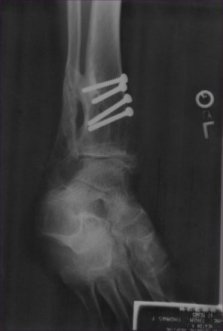
X-Ray Taken On April 22nd 2004
Leg Fracture Date: May 27, 1996
Diagnose
Fully Exposed Multiple Compound Fracture Left Leg
02/10/2007 MRI Results
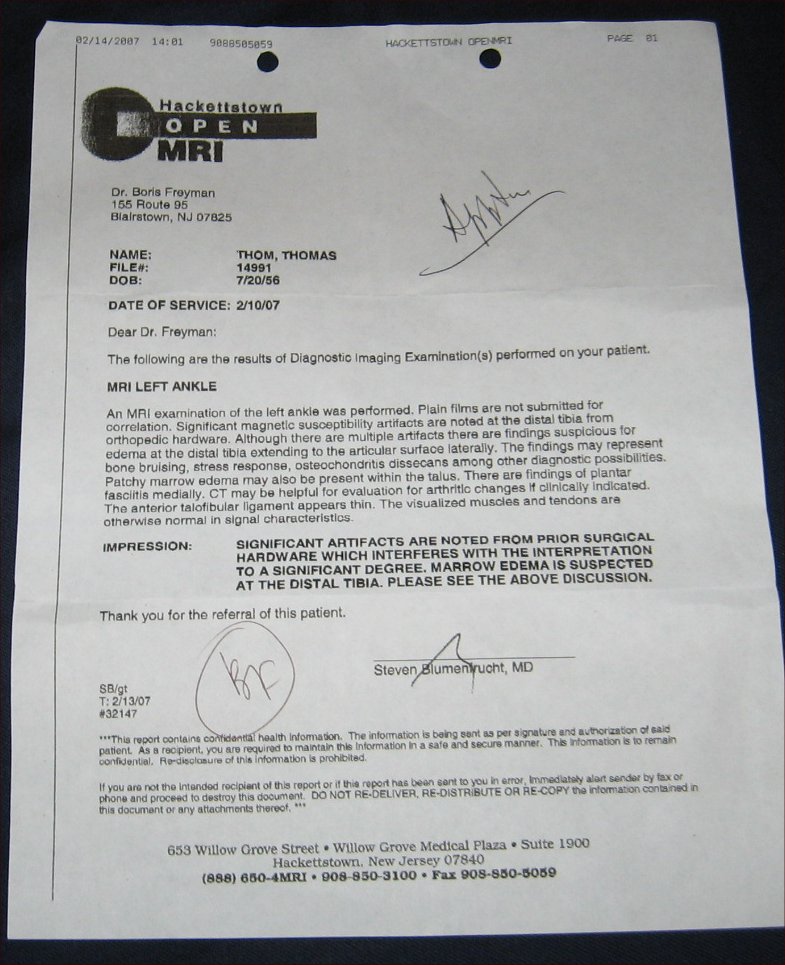
Oedema
Edema without a modifier usually refers to peripheral or dependent oedema, the accumulation of fluid in the parts of the body that are most affected by gravity.
Marrow Oedema
It has been suggested that transient osteoporosis or the bone marrow oedema syndrome (BMOS) may be the initial phase of osteonecrosis of the femoral head (ONFH) and that there may be a common pathophysiology. In this study, we have assessed the MR images of 200 consecutive patients with ONFH in respect of the BMO pattern in order to test this hypothesis.
This pattern was not observed in the early stage of ONFH. The initial abnormal finding detected on the MR images was an abnormal band of intensity at the junction between the necrotic area and the normal bone. Structural damage of the head seems to result in the appearance of the BMO pattern and the development of pain in ONFH. There was no finding to support the existence of a continuum between BMOS and ONFH.
os�te�o�chon�dri�tis
Inflammation of a bone along with its cartilage.
Plantar fasciitis medially
Plantar Fasciitis and Plantar
Heel Pain Syndrome
by Stephen M. Pribut, DPM
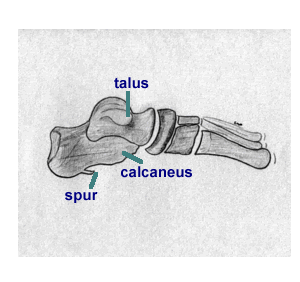
Plantar fasciitis is the most frequently encountered cause of plantar heel pain. For many years this clinical group of problems has been incorrectly termed the "heel spur syndrome" while it is better termed a "plantar heel pain syndrome". Heel spurs sound ominous, but they can be present and not cause any pain. The formation of a spur is a sign that too much tension has developed within the plantar fascia, and it may have partly torn from its origin at the calcaneus (heel bone).
The pain of Plantar Fasciitis, which is the most common heel problem, seems to be caused by a painful partial tearing or avulsion of the plantar fascia most often at the portion attached to the medial calcaneal tuberosity. This tearing can sometimes result in a heel spur forming (from the injured bone attempting to heal itself). The heel spur itself, as we have mentioned, is not the cause of the pain. Plantar fasciitis or the injured tissue is the cause of the pain. Tenderness is usually found right at this location on the medial calcaneal tubercle.
The term plantar fasciitis is derived from plantar which refers to the bottom of the foot and fascia which is a type of dense fibrous connective tissue. The "it is" is a suffix which means inflammation. Latest studies show that in many cases of plantar fasciitis there really is no inflamation, but rather an avascularity ( loss of blood circulation ). This may be similar to what has been termed Achilles Tendinosis (rather then tendinitis). Lemont has termed it a fasciosis.
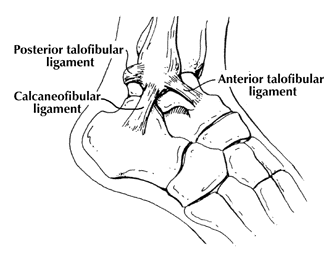
anterior talofibular Ligament
Injuries to the ligaments about the ankle usually result from inversion and internal rotation of the foot combined with ankle plantar flexion. If all three ligaments are ruptured, the ankle is unstable. With complete disruption of the anterior talofibular ligament, forward displacement of the talus in the ankle mortise is present. With sequential rupture of the anterior talofibular and calcaneofibular ligaments, there is medial tilting of the talus with progressive widening of the lateral joint space. Avulsion fracture of the medial malleolus and disruption of the anterior inferior tibiofibular ligament are associated with abduction and laterally directed forces.
Top page

Return to main Index