Sands of Dreamtime
In Australia, two different traditions are working side by side to widen the window on the past. The knowledge of local Aborigines combined with the techniques of modern archaeology is is allowing the dreamtime to materialize.
By revealing the antiquity of aboriginal occupation, scientists digging in remote locations can influence some of the social and political issues now making headlines... like native title and the Wik decision. Currently one of the most famous sites in the country is Jinmium. What’s being unearthed here is especially timely because it threatens to unravel long held theories about the origins of all modern humans.
According to archaeologist, Dr Alan Thorne, “There's always been people who for various philosophical or scientific or political reasons have wanted aborigines to have only arrived the week before last Tuesday, and those who have thought that aboriginal people may well have evolved partially here, and have made adaptations physically and culturally over a very long period.”
The current accepted estimates of earliest occupation float somewhere between 40,000 and 60,000 years. But in the last 12 months there’s been talk in scientific circles of dates as old as 150,000 years. Conventional wisdom holds that at that time Homo sapiens was only just venturing out of Africa. So if this date were to prove correct there’d have to be a major reassessment of how humans spread across the globe.
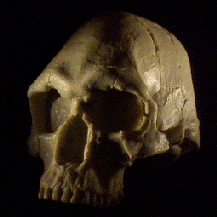
Last century Australian aboriginal people were seen to be almost living relics of an ancient period in human evolution, equivalent to Europe's stone age. This view was based entirely on superficial observations of lifestyle. There was no archaeological work going on. Then in 1914 a badly damaged but apparently old skull came to the attention of famed geologist, Sir Edgeworth David. The skull had been unearthed thirty years before, by a workman, named William Naish. Intrigued, David tracked down the workman, now aged seventy-six, which took him to Talgai in Queensland’s Darling Downs. When he reached the creek where the skull had been found, he also discovered the bones of extinct giant marsupials. This convinced him that the Talgai skull and Australia’s aborigines were “stone age”.
Professor Rhys Jones from the Australian National University picks up the story. " Edgeworth David had said that the skull had ‘a geological antiquity’, which if you translate it to present day figures might be hundreds of thousands of years. However when people actually began to do field work and they began going back to some of these sites then all these huge claims collapsed and you have a successive collapse of these claims. Then an alternative view starts which you can see after the Second World War. It’s a very conservative view which says, no. Aboriginal people and their ancestors have only been in Australia a short time, say 5 or 6,000 years. And that was the situation widely believed until the invention of radio-carbon dating. “
Few realise it today but it was atomic bomb research that gave archaeology its most powerful tool, radiocarbon dating. Physicists working on the Manhattan Project discovered, not only that a radioactive form of carbon, known as carbon-14, is present in all living things but that it decays progressively allowing us to date them.
When something dies its C-14 begins to disintegrate. 5700 years later, half the C-14 will have gone. After 11,000 years there’ll be half as much again and so on. So you can calculate age by measuring how much C-14 is left.
“All you had to do,” adds Rhys Jones, “ was to get a piece of carbon, say charcoal from fires, very common at archaeological sites or bits of shell or in some cases bits of bone and you can then put this into what is effectively a sophisticated Geiger counter and measure the amount of carbon-14 that was still left in that sample.”
Now the real age of the Talgai skull could be determined.
Sydney University’s Professor Neil Macintosh had already revised Edgeworth David’s wild overestimate, but his estimate was still just an educated guess. Speaking on an ABC documentary back in 1967 Macintosh put it like this. “Tentatively for the moment we are thinking in terms of 12,000 years. But it’s necessary to admit that this is very largely a deductive process and we would much rather have some direct evidence.“
Radiocarbon dating would confirm that the Talgai skull was between 9,000 and 11,000 years old, pretty close to Macintosh’s guess.
“The advent of radiocarbon dating was absolutely critical,” says Alan Thorne, “because it gave us for the first time a series of fundamental benchmarks in archaeological sites and for environmental events which may or may not have had anything to do with humans.”
Alan Thorne was involved in a string of major discoveries about aboriginal prehistory in the late 60s and early 70s. In 1969 he was asked to piece together a shattered skeleton that had recently been found in the dunes of Lake Mungo in western NSW. The remains were in thirteen blocks of cemented sand.
“When the first of the Mungo individuals was passed to me,” Alan recollects, “the woman that the aboriginal people now call ‘the Mungo lady’, she was in a very large of number of pieces and just this part of the skull alone, from the brow ridges to the back of the head was in about 450 pieces because she had been badly burnt and deliberately smashed so that pieces of skull were just lying everywhere. And just reconstructing this much took just on 6 months. But it was a very exciting time because, you know, we suspected that she was 25,000 and that made her then the worlds oldest human cremation. “
Over the years the sands of Lake Mungo have yielded many skeletons, dated well beyond 20,000 years. But most striking is the fact that they all appear to be very lightly built people, with quite delicate features, a characteristic that suggests they were anatomically very modern. They’re quite unlike the extraordinary human remains found at Kow Swamp, in Victoria in the early seventies
Once again Alan Thorne was involved. “Kow Swamp was discovered essentially by accident. Someone had been stealing skulls from the museum of Victoria and my professor in Sydney sent me down to to make a catalogue. And it was while I was doing that that I discovered these old bones or fragments of a skull and some post cranial skeleton in an old shirt box which had some funny data on it. The curator of anthropology in the museum and myself tracked down these remains to a place called Kow Swamp, and it was there that I was able to find additional pieces that fitted together.” He reaches for a large and extremely impressive skull resting on the table. “And in fact this is the skull that we’re talking about. This is Kow Swamp One and I was actually able to match a piece of bone here with another piece of bone from the site and then we dated it and found that it was about 10,000 years old so that was the beginning of the excavations of Kow Swamp which over a period of three years of course produced the remains of more than 50 or 60 individuals.”
The Kow Swamp people have thick brow ridges, very large faces and the biggest teeth that have ever existed in modern humans. And that creates a problem. They look ancient but at 10,000 years of age they’re much younger than the lightly built Mungo people. How could that be?
In a controversial demonstration, in 1975 Professor Neil Macintosh put forward one explanation. Drawing on a collection of some 14,000 skulls of recently dead aborigines he chose a sample that for him represented the range of features.
“This group here consists of the females. The most female-looking female is on that side and the least female-looking female is over there. There’s a gap between the sexes. This is the least masculine-looking male and this here is the most masculine male.” “So that we can say,” Professor Macintosh concluded, “in this total overall series we are going continuously from the most gracile of the females to the most rugged of the males. And if we were to contrast the two extremes, the difference between the gracile female and the rugged male is absolutely striking.”
In other words what seemed like two physically distinct populations, Macintosh believed was just one. It was a point of view not shared by everyone. Alan Thorne explains. “There have always been people who have thought that all variation in Australia is a function of a single founding population. They’re referred to as homogeneity theorists. There's always been one or two of those but they're very much in the minority. Most people have assumed for good reasons that various types of people have come in at different times and mixed together to produce modern aborigines in much the same way as is true for virtually every human group anywhere in the world.”
As more archaeological sites were discovered in the 70s the timetable for the settling of Australia changed very quickly. Radiocarbon dating pushed antiquity back thousands of years at a time. By 1975, occupation dates of 35,000 years had been found. In fact a whole cluster of sites logged in between 35 and 39,000 years. But when no dates older than that could be found some people began to suspect that radiocarbon dating wasn’t telling them the truth.
Rhys Jones was one of them. “Now the question then is, is this really the age of the arrival of people on the Australian continent, roughly thirty-eight thousand years? Is that really the case or are we just looking at the limits of the radio-carbon method. Are we just on the very edge of this method that we can’t see beyond so that all dates beyond will give you this number of thirty-eight thousand.”
At a spectacular rockshelter in West Australia’s Kimberley region, archaeologist, Sue O’Connor believes she’s encountered the so-called radiocarbon barrier, some technical limitation of the method that gives false estimates of age. In an excavation trench below this ledge she recorded radiocarbon dates for the charcoal from ancient campfires. The dates got progressively older and the sand redder as she dug deeper, pretty much what you’d expect. That is until she reached the 40,000 year mark. Thereafter she still found charcoal and stone tools but the radiocarbon date remained stuck on 40,000.
“If the radiocarbon barrier exists,” says Sue, “then this is one site that suggests that it does because the likelihood that you would actually have 2 dates sitting on 40,000 separated by 20 centimetres of deposit, in a site which has got a fairly slow rate of sediment deposition... At that depth of deposit, what that’s essentially telling you is we’ve hit the radio carbon barrier. “
Theoretically, carbon dating should give ages back to 70,000 years or so. But charcoal sometimes absorbs more recent carbon from the soil making it seem much younger than it really is. Alan Thorne considers the implications. “It doesn't mean that there's a sudden rush of people into Australia at that time. It’s just simply the physics of radio carbon. What it means is that most of these sites dated to thirty five to forty thousand are probably much older than that.”
Most of the sites dated around the 35 to 38,000 year mark are in southern parts of Australia where charcoal preserves well. But as researchers turned their attention to the north of Australia they encountered another problem. Buried charcoal doesn’t preserve well in the tropics. It gets oxidised out of the soil leaving nothing to date. In Arnhem Land in 1981, a team that included Rhys Jones was working in remote Deaf Adder Gorge, where the sense of deep antiquity is tangible.
“We excavated in this site and I’m faced with this great big sections and one of those kind of turning points in one’s life as it were as an archaeologist. You’re in this section and down at the base which is 3 metres high is full of artefacts all the way down to the bottom. I know the artefacts at the base are old because you can snap them and they’ve got these thick weathering skins in them, right? But the problem is carbon only goes down to about half way and the dates from the carbon was about of somebody else’s excavation at 22,000 from our own from about 24,000 and then from then on the artefacts are there. There’s no carbon. It’s all been oxidised and I felt myself then, I will never know the age of the base of that site, but I do know it’s old. But then paradoxically what I didn’t realise was that a new technique had just been discovered which is the thermoluminescence technique for the dating of when sands were last exposed to sunlight.”
Classical Greek vases were the first objects to be dated with a new method known as thermo-luminescence. It’s based on a clock built into the crystals of quartz, found in clay and sand. And it’s capable of reaching back much deeper in time.
David Price is a geochronologist at the University of Wollongong. He uses thermoluminescence to measure the age of ancient sands. “Carbon dating works on something that's been living, organic material, whereas thermoluminescence works on inorganic crystals,” David says. “The other thing is of course that thermoluminescence will reach back much further in time than carbon-14.”
The principle behind the method is simple. Ordinary sand when it’s buried absorbs and traps energy from the earth ! Over time, this energy accumulates. But if you dig up the sand and rapidly heat it in one of these cylinders all that energy is released in a flash of light. The intensity of that light corresponds to how long the sand has been buried. Sunlight, or ultra-violet light also releases the stored energy and resets the crystal clock. So just to be safe David Price works in a dim yellow room.
Thermoluminescence doesn’t directly date objects unearthed at a site. But it does reveal when they were last used. In the mid ‘80s Rhys Jones put thermo-luminescence to the test. At another rock shelter in Arnhem Land, known locally as Malakunanja, an excavation was underway. Beneath sheer walls with faded paintings the team opened a deep trench. Rhys describes what they found. “It was just over five metres of sand which is quite deep in that part of the world. There’s occupation in every single layer down to about two and a half metres. Every single layer has got artefacts. I mean there are thousands of artefacts...”
When the layer of sand just beneath the deepest stone tools was dated using thermo-luminescence it registered a staggering 60,000 years. That meant Malakunanja was more than 20,000 years older than any site dated using radiocarbon. Immediately the dates and the method were questioned.
To add weight to the claim, dating expert, Bert Roberts, retested the site in 1993 using a refinement of the thermoluminescence technique known as OSL, or optically stimulated luminescence. As the name implies, bright light, rather than heat, is used to release the energy from the sand. OSL supported the idea that people first visited Malakunanja between 50 and 60,000 years ago.
There’s at least one other site in the top end that can make the same boast. It makes perfect sense that the oldest sites of occupation are in the far north. It’s the closest landfall for anyone voyaging from New Guinea or the islands of Indonesia.
But before people could get comfortable with the idea of 60,000 years, a startling sequence of events threatened to shift the timescale again.
In the floor of an ancient crater in Queensland’s Atherton Tablelands is a deep swamp. It’s so deep that researchers can find clues to how this landscape looked hundreds of thousands of years ago. From cores of the sticky ooze, a team from Melbourne’s Monash University have been finding prehistoric plant remains including beautifully preserved seeds and pollen. Under the microscope these botanical miniatures have an interesting story to tell.
Two hundred thousand years ago Australia was a much greener place. But the continent was well on its way to drying out. We know there were several ice ages and each time the vegetation changed dramatically.
The pollen records tell us that dense rainforest gave way to forests of native pines, known to scientists as Araucaria trees. As the world thawed then cooled again the pattern was repeated. But 38,000 years ago in the middle of the last glacial, something inexplicable happens. There’s a big increase in the number of bush fires. And in their wake the vulnerable pine forests vanish only to be supplanted by fire tolerant trees like Eucalypts. Question is, who was lighting the fires? Dr Peter Kershaw from Monash University has one explanation. “Well essentially the change about 38,000 years ago doesn't correspond to a time of major climate change... This event did not occur in the previous glacial period when it was equally dry. Therefore it suggests that people could well have been responsible. And of course 38,000 is very close to the earliest date for most long archaeological records within the Australian region.”
Here was evidence, though circumstantial, of people making their mark on the landscape. Since the traditional use of fire is now well documented, many archaeologists accepted the story from Lynch’s Crater. But the next discovery didn’t go down so well.
Much of what’s now our continental shelf was dry land in the past. So when researchers aboard this vessel drilled just offshore from Lynch’s Crater they found a detailed record of the lost coastline. And the cores they brought up from the seafloor were huge.
Peter Kershaw was on board. “We looked at one of the cores. It was 450 metres in length. Through the last 1.4 million years very little change had occurred in the vegetation in this particular region, until somewhere between 100 and 150,000 years before present. And what we found to our surprise was that we got exactly the same scenario as we had on the Atherton Tablelands, 38,000 years ago...“
So according to these cores there were fires not just at 38,000 years but also more than 100,000 years ago. Once again the question? Who or what was responsible? “We have I think a very clearly established impact at thirty-eight, forty thousand years ago. And the fact that you’ve got similar events occurring earlier I think strongly implicates humans in the explanation for these these particular changes.”
This time, archaeologists weren’t so ready to accept the explanation. Peter adds, “Well I suppose the archaeological record has been constantly being extended back in time and therefore I am a little bit surprised at their reluctance.”
That reluctance was jolted in September 1996 by some extraordinary claims. There was news of enormous sculpted boulders, and puzzling engravings. And ancient stone tools were unearthed from sands dated at more than 116,000 years old. The site was called Jinmium. Fuelled by intense media scrutiny it has reignited the debate about the first Australians.
If the controversial claims prove correct there are implications for the story of our species. But as we’ll discover the work at Jinmium is about much more than dating the dreamtime.
Top Page
Return to main Index