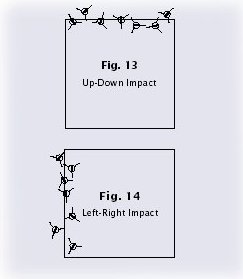
Up-Down Impact
Using fletched arrows only, shoot approximately 6 to 8 arrows along the top edge of the target face. This step determines if your nocking point is correct. See Fig. 13. Normally, small tuning problems show up at close range,
because the arrow has its maximum oscillation at short distance. This test assists you in identifying these arrow flight problems and makes it possible to make finer adjustments than with the previous tuning procedures. If you are unable to consistently hit the top edge of the target face, there is probably a small tuning disturbance in the equipment. To correct, make a 1/32" (.8 mm) nocking point adjustment either up or down and shoot again. Continue making nocking point adjustments in 1/32" (.8 mm) increments (no more than 1/32" (.8 mm) at a time). If your arrows are hitting the top edge of the paper more consistently and you are achieving a straight, horizontal line of arrows across the top of the paper, you are correcting the disturbance. If the horizontal line of arrow impact is widening, go back to your original nocking point position and start making 1/32" (.8 mm) nocking point adjustments
in the opposite direction. This will provide you with the correct nocking point position.
Left-Right Impact
Once you have achieved the straightest horizontal line of arrows that your ability will allow, you are ready to tune for left/right arrow impact. Shoot 6 to 8 arrows at the left edge of the paper in a vertical line. See Fig. 14.
To improve the left/right impact for CR and CF archers, move the in/out position of your arrow rest. This is done to compensate for the effect of the
eccentric wheel. The offset of the eccentric wheel on compound bows does not always compensate for the degree of natural torque generated in the bow. The wheel often torque’s or leans over slightly as it reaches the
full draw position. This is common and is nothing to be concerned about. At full draw, the "limb center" you started with in the preliminary setup may not really be the true balanced center. Therefore, through some trial and
error, you must locate the best in/out position for the arrow to obtain maximum accuracy. Make a 1/32" (.8 mm) adjustment either in or out and shoot again. Continue making 1/32" (.8 mm) adjustments until
This tear indicates a weak arrow reaction or clearance problem for right-handed finger release (RF, CF) archers. Left-handed finger release archers will have the opposite pattern. For right-handed compound archers using mechanical releases (CR), the left tear is common and usually indicates a weak arrow reaction and/or clearance problem. If a high-left tear exists, (see
next tear illustration) make sure you correct the nocking point first before proceeding further.
Finger Release (RF, CF)–To correct:
1. Check for Clearance (See page 5).
2. Decrease bow weight/peak bow weight.
3. Use a lighter arrow point and/or insert combination.
4. Use a heavier bowstring (more strands or heavier
material).
5. Use a stiffer spine arrow.
6. Increase cushion plunger tension or use a stiffer spring
on "shoot around" rests.
7. CF only - Move the arrow rest slightly out, away from
the bow.
Mechanical Release Aid (CR)–To
correct:
1. Move the arrow rest to the right. Continue to move the rest to the right in small increments until the left tear is eliminated.
2. Make sure the bow hand is relaxed to eliminate excessive bow hand torque.
3. Decrease peak bow weight.
4. Choose a stiffer spine arrow.
This tear shows a combination of more than one flight disturbance. Use the
procedures that apply to the tear pattern for your style of shooting, and combine the recommendations, correcting the vertical pattern (nocking point) first, then the horizontal. If you experience a tuning problem (especially with the nocking point location) and are unable to correct a high/low tear in the paper, have your local pro shop check the "timing" (roll-over) of your
eccentric wheels or cams. For archers using release aids, it may, in some cases, be necessary to apply adjustments opposite from those
described. The type of arrow rest and release aid combination used can alter the dynamic flex of the arrow to produce tear patterns contrary to those indicated (although it is uncommon). Once you have achieved a good tune at 4 to 6 feet (1.2-1.8 m), move back 6 feet (1.8 m) more and continue to shoot
through the paper. This ensures that the tune is correct and that the arrow was not just in a recovery position when it passed through the paper at the first distance.
9 you achieve the best possible vertical impact line of arrows. If the vertical line widens, go back to your original arrow rest position and move it 1/32" (.8 mm) in the opposite direction. If the vertical line narrows, continue
1/32" (.8 mm) adjustments in that direction until you achieve
the straightest line possible. CF archers using cushion plungers should make the necessary arrow rest adjustments and then try a second tuning adjustment using the cushion plunger's spring tension. Increase or decrease spring tension 1/8-turn at a time. Again, if the vertical line becomes wider, return to the original spring tension setting and make 1/8-turn adjustments in the opposite direction until you achieve a narrow vertical impact line.
RF archers should make cushion plunger spring tension adjustments only, increasing or decreasing the spring tension 1/8-turn at a time. If the vertical line becomes wider, return to the original spring tension setting and make 1/8-turn adjustments in the opposite direction until you achieve a narrow vertical impact line. Do not move the in/out position of your arrow. The position of your arrow to the centerline of the bow has already been established in the preliminary equipment setup.
Return to main Index