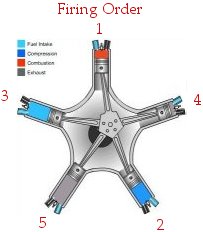
This a 5 cylinder Radial Airplane Motor
Fire Cyl 1
Fire Cyl 5 Fire Cyl 2
If you have ever seen a World War II bomber like the B-25 or the B-17, or if you have ever seen or been on an old commercial airplane like a DC-3, then you are familiar with something called a radial engine. Many planes of the WWII era used very large, very powerful radial engines to drive their propellers.
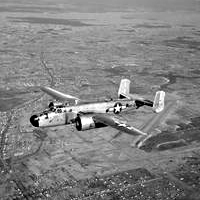
In this article, you will learn how the radial engine works, what makes it different from other engine configurations and why it fits in so well with airplanes.
You can see in the illustration that this is a five-cylinder engine -- radial engines typically have anywhere from three to nine cylinders. The radial engine has the same sort of pistons, valves and spark plugs that any four-stroke engine has. The big difference is in the crankshaft.
Instead of the long shaft that's used in a multi-cylinder car engine, there is a single hub -- all of the piston's connecting rods connect to this hub. One rod is fixed, and it is generally known as the master rod. The others are called articulating rods. They mount on pins that allow them to rotate as the crankshaft and the pistons move
Applications
Radial engines have several
advantages for airplanes:
Radial engines reached their zenith during WWII. There are some radial engines around today, but they are not that common. Most propeller-driven planes today use more traditional engine configurations (like a flat four-cylinder) or modern gas turbine engines. Gas turbines are much lighter than radial engines for the power they produce.
One place where you can still see the influence of the radial engine concept is in the two-cylinder engine of a Harley Davidson motorcycle.
Harley-Davidson Motors are Radial Motor’s also!
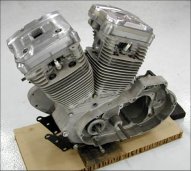
The engine from a Harley can be thought of as two cylinders from a radial engine.
It can be thought of, in a way, as two pistons from a radial engine. In a Harley, both pistons share a single connection point to the crankshaft, like in a radial engine.
What gives a Harley-Davidson motorcycle its distinctive sound?
There is no denying that a Harley-Davidson motorcycle has a unique sound, especially if the mufflers have been removed! Even with the mufflers on, however, it sounds different. The reason for the sound has to do with the way the engine is designed.
A piston goes through the intake, compression, combustion and exhaust strokes every two revolutions of the crankshaft. When your lawn mower is idling, you can hear the pop-pop-pop-pop sound of the individual strokes. What you are actually hearing is the sound of the compressed gases in the cylinder escaping when the exhaust valve opens. Each pop is the sound of the exhaust valve opening one time, and it happens on every second revolution of the crankshaft.
In a two-cylinder, horizontally opposed engine, the pistons are timed so that one fires on one revolution of the crankshaft and the other fires on the next revolution -- so one of the two pistons fires on every revolution of the crankshaft. This seems logical and gives the engine a balanced feeling. To create this type of engine, the crankshaft has two separate pins for the connecting rods from the pistons. The pins are 180 degrees apart from one another.
A Harley engine has two pistons. The difference in the Harley engine is that the crankshaft has only one pin, and both pistons connect to it. This design, combined with the V arrangement of the cylinders, means that the pistons cannot fire at even intervals. Instead of one piston firing every 360 degrees, a Harley engine goes like this:
A piston fires.
The next piston fires at 315 degrees.
There is a 405-degree gap.
A piston fires.
The next piston fires at 315 degrees.
There is a 405-degree gap.
And the cycle continues.
At idle, you can hear the pop-pop sound followed by a pause. So its sound is
pop-pop...pop-pop...pop-pop. That is the unique sound you hear!
Top Page

I urge anyone seeking information such as this to use howstuffworks.com
Harley Motor or Trans questions?
Mail to

Return to main Index